The KUCR Radio Archives Project
Below: Two of KUCR’s founding members, station manager Hans Wynholds (foreground) and engineer Bill Farmer, inside the original station building that is still in use today, c. September, 1966. Photograph by Ansel Adams.
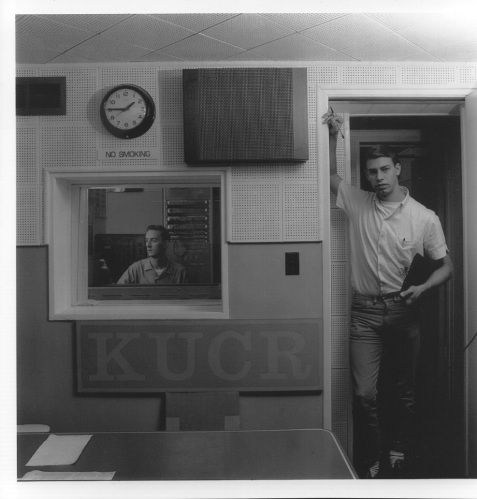
To view excerpts from Fiat Lux by Ansel Adams and Nancy Newhall, where the above photograph was originally published, please click here.
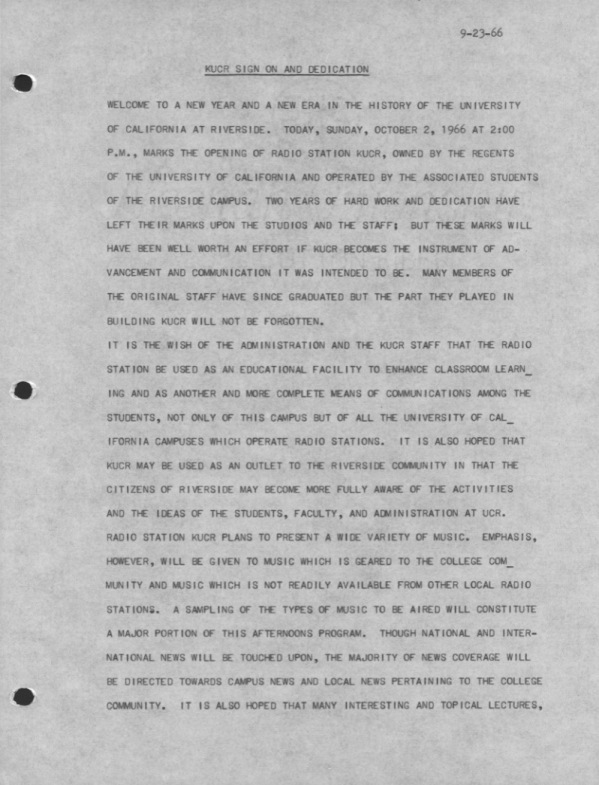
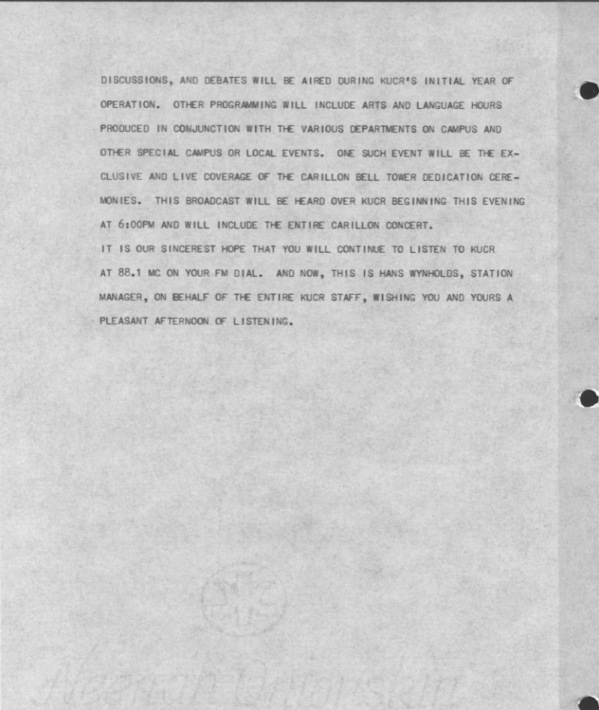
Below: Original script for the first KUCR sign-on read by Hans Wynholds at 2pm on October 2nd, 1966.
See more at the KUCR Archives Photo Gallery
Read about some of the station’s early history at the link below:
KUCR history with photos by Bob Stubenrauch, KUCR Station Manager from 1968-70.
Gary Kern reflects upon KUCR, broadcast personalities and the irretrievable passage of time on the occasion of the station’s 50th anniversary.
KUCR Historical Audio & Original Programming
To hear original audio material produced by KUCR, click here.
About the KUCR Radio Archives Project
KUCR 88.3FM in Riverside, CA is a non-commercial college and community radio station that began broadcasting from the campus of the University of California, Riverside at 2pm on the afternoon of Sunday, October 2, 1966. The station serves a diverse community in the inland southern California area, and has been broadcasting from the same building and location since it’s inception.
KUCR features a wide range of original programming produced by students, staff, faculty and alumni from UC Riverside. Music programs span genres from Korean Pop (K-Pop) to classical, jazz, hip-hop, cumbia, gospel, reggae, dubstep, funk, and soul. KUCR public affairs programs also address fields such as anthropology, history, sociology; language arts, psychology, philosophy and the performing arts, among many others. Original programs include ‘Soul On Sunday,’ ‘Indian Time,’ ‘Radio Aztlán,’ ‘Auto Talk,’ ‘Highlander News Room,’ ‘As A Matter of Fact,’ ‘Oasis,’ ‘Fiesta en San Juan,’ ‘Roundtable Roundup,’ ‘Arts Alive!’ and ‘Jazz Tuesday’, which are but a few examples of the myriad and diverse array of shows that station volunteers and staff have produced over the past five decades, and counting.
Producing original programming provides firsthand access and training for campus-based DJs, and provides a venue for both up–and–coming as well as established artists and academics from around the block and around the world to share their work and ideas. KUCR is unique as a college and community radio station, both for the diversity of its programming as well as its long history on the air.
The KUCR Archives Project serves to document material from this history, in order to ensure public access to an invaluable resource for those interested in the history of KUCR, public broadcasting, college radio and a broad range of topics.
Station Origins
KUCR’s origins can be traced to a group of students who, legend has it, utilized a metal trashcan as an antenna to operate a pirate radio station from a dorm room in the UCR Steinbrau student housing complex in the early 1960s. These first broadcasts were primarily popular music shows hosted by student DJs, who used aliases in order to avoid prosecution by the FCC.
The Federal Communications Commission (FCC) eventually moved to have the unlicensed, student-operated pirate radio station closed down. In the spring of 1964, Chancellor Ivan Hinderaker was approached by a group of students that included Hans Wynholds and Bill Farmer, the station’s respective founding manager and chief engineer, to secure a broadcasting license and establish KUCR, originally at 88.1 on the FM dial. Chancellor Hinderaker subsequently worked with that group of students to secure $10,000 from the UC Regents and establish a licensed, student-run station at UCR.
The regents were reluctant to grant funding for the project in the wake of the UC Free Speech Movement (FSM). Stemming from student organizing efforts primarily at the Berkeley and Riverside campuses, working with groups including the Congress of Racial Equality, the FSM sought to address social justice issues including widespread socioeconomic disparity, US involvement in the Vietnam War, institutionalized racism, and UC administrative attempts to curb any campus-based political activism and organizing (which was investigated and judged to be a clear violation of students’ free speech rights).
The FSM of 1964-65 instigated a period of growth in campus-based activism throughout the UC system that reflected key aspects of ongoing civil rights movements and related events. The regents feared KUCR might act as an additional outlet for proponents of the FSM, and in order to obtain funding and approval for the purchase of a broadcast license, Chancellor Ivan Hinderaker volunteered to take personal responsibility for the content of all KUCR broadcasts. The regents eventually approved the purchase of a broadcast license for the station in early 1966, and the station went live on-air that fall.
William “Bill” Elledge
One of the founding members of KUCR was William ‘Bill’ Elledge. As an undergraduate student, Mr. Elledge began work as an electrical engineer and programmer at KUCR in the summer of 1966, and remained with the station as chief engineer until his passing in 2009. Mr. Elledge was an integral figure at KUCR and possessed an extensive collection of material related to the stations history. His collection included original programming in a variety of media formats and station ephemera dating from the mid-1960s. An avid documentarian, Mr. Elledge acted as an unofficial archivist for KUCR, as well as the broader UCR community, during his time at the station and on campus.
Mr. Elledge worked extensively with the UCR Highlander newspaper, conducting interviews, publishing editorials and preserving copies of the paper and related items in his home. Mr. Elledge additionally hosted a popular classical music and commentary program that aired on KUCR from 1971 to 2008. His personal record collection is reported by Louis Vandenberg, KUCR station director who worked with Mr. Elledge for many years, to have exceeded 30,000 albums.
Historical Material
KUCR archival material includes items of social, cultural and political significance from UCR and surrounding communities: numerous interviews and programs produced by and with people including Dr. Sterling Stuckey, Oscar Brown, Jr., Dr. Angela Davis, Alex Haley, Governor Jerry Brown, Stokely Carmichael, and Ray Bradbury, among many others. For over fifty years, KUCR has remained a vibrant community resource for news, analysis, public affairs, music, education, arts, and culture.
Imagine if all that remained of history’s recorded conversations, performances, speeches and other relics of the past were written transcripts, at best. The ability to record, store and replay audiovisual media is a relatively recent and significant development in human history, or hustory. These developments have enabled people to record and reproduce our expressions and experiences in unprecedented ways, and subsequently engage the world we inhabit with a new range of artifacts unique for their capacity to capture events in real-time.
History is inevitably lost unless people act on the imperative to preserve it, in all its myriad formats. Both determining what merits preservation and then acting upon that designation are critical steps to establish and maintain any record of human experience. Audio archives and the material they contain constitute compelling and insightful facets of human history that will continue to yield knowledge and insight to those who seek it for generations to come, so long as they are safeguarded.
Places such as KUCR and community radio stations around the world not only produce but help document, preserve and share the stories which encompass the depth and breadth of human experience. Independent radio stations do this in a non-commercial setting, which permits the creative exercise of an interstitial space for humanity to experiment, grow and expand. Spaces such as these encourage the exploration and growth of human consciousness, and the experiences which shape it.


